
An estimated 47.2 per cent of adults in the United States met federal guidance for leisure-time aerobic activity in 2024, according to a National Center for Health Statistics report published in April 2026.
The result is useful for tracking participation, but it is easy to overread. The survey did not measure every form of movement across a person's day, and it does not show that the remaining 52.8 per cent did nothing. Nor does meeting a time threshold establish a person's overall health.
The more constructive question is what the data reveal about opportunity. Participation differed by sex, education, region, disability and reported health. Those patterns point towards environments, resources and access as well as personal circumstances.
What the survey measured
The report analysed responses from the 2024 US National Health Interview Survey. Adults were classified as meeting the federal aerobic guideline if they reported enough moderate-intensity activity, vigorous-intensity activity or an equivalent combination during their leisure time.
The publication reported that 52.3 per cent of men and 42.4 per cent of women met the aerobic threshold. Participation increased with education, and adults in the western United States were more likely to meet it than those in other regions. Adults without disabilities, those reporting excellent or very good health and those in the healthy-weight category also reported higher participation.
These are descriptive associations. They do not establish why the differences occurred, and they should not be used to blame groups with lower reported participation.
Leisure-time activity is only part of movement
Someone may walk, lift, carry, wheel or stand during paid work, care, transport or household tasks without describing it as leisure exercise. Conversely, physically demanding work may create fatigue or injury risk rather than the same choice and recovery associated with recreational activity.
Self-reported surveys also depend on memory and interpretation. People may differ in what they count as moderate intensity or how accurately they recall duration. The survey offers a consistent national estimate, not a complete measurement of each participant's movement.
The data are specific to the United States. They should not be presented as a global rate or assumed to describe another country's transport, employment, safety, climate or access to public space.
Why access changes what is realistic
Advice to “move more” can sound simple while ignoring the conditions that make movement possible. Relevant factors include:
- Safe pavements, crossings, parks and cycling routes
- Affordable and accessible facilities
- Time outside paid work and caring responsibilities
- Transport and neighbourhood design
- Disability-inclusive equipment and instruction
- Protection from harassment, violence, extreme heat and air pollution
- Symptoms, recovery, pain and changing energy
The education gradient in the survey should not be interpreted as evidence that education itself creates motivation. Education can be associated with income, working conditions, neighbourhood resources and schedule control. The report adjusts or compares selected characteristics, but an observational survey cannot untangle every pathway.
What the activity target is for
Public-health guidelines use weekly targets to communicate the amount of aerobic activity associated with broad population benefits. CDC describes benefits from both single sessions and regular activity, including effects on sleep, anxiety, blood pressure and long-term risk of several chronic diseases.
A threshold is not a pass-or-fail test. People below it may still gain benefit from activity, while people above it can have health conditions and different support needs. The right type and amount of movement depend on access, preferences, ability, health and starting point.
Anyone with a condition, injury, concerning symptom, pregnancy-related question or recent procedure may need individual guidance. This article cannot determine whether a particular activity is safe.
Practical ways to reduce the starting barrier
For people who want and are able to add movement, the first useful step can be smaller than a full weekly programme:
- Choose a form of movement that fits the environment and body available today
- Attach a brief period of movement to an existing routine
- Use a comfortable pace that leaves room to notice pain, dizziness or unusual breathlessness
- Build frequency or duration gradually rather than compensating for a missed day
- Keep a smaller version for busy, low-energy or poor-weather days
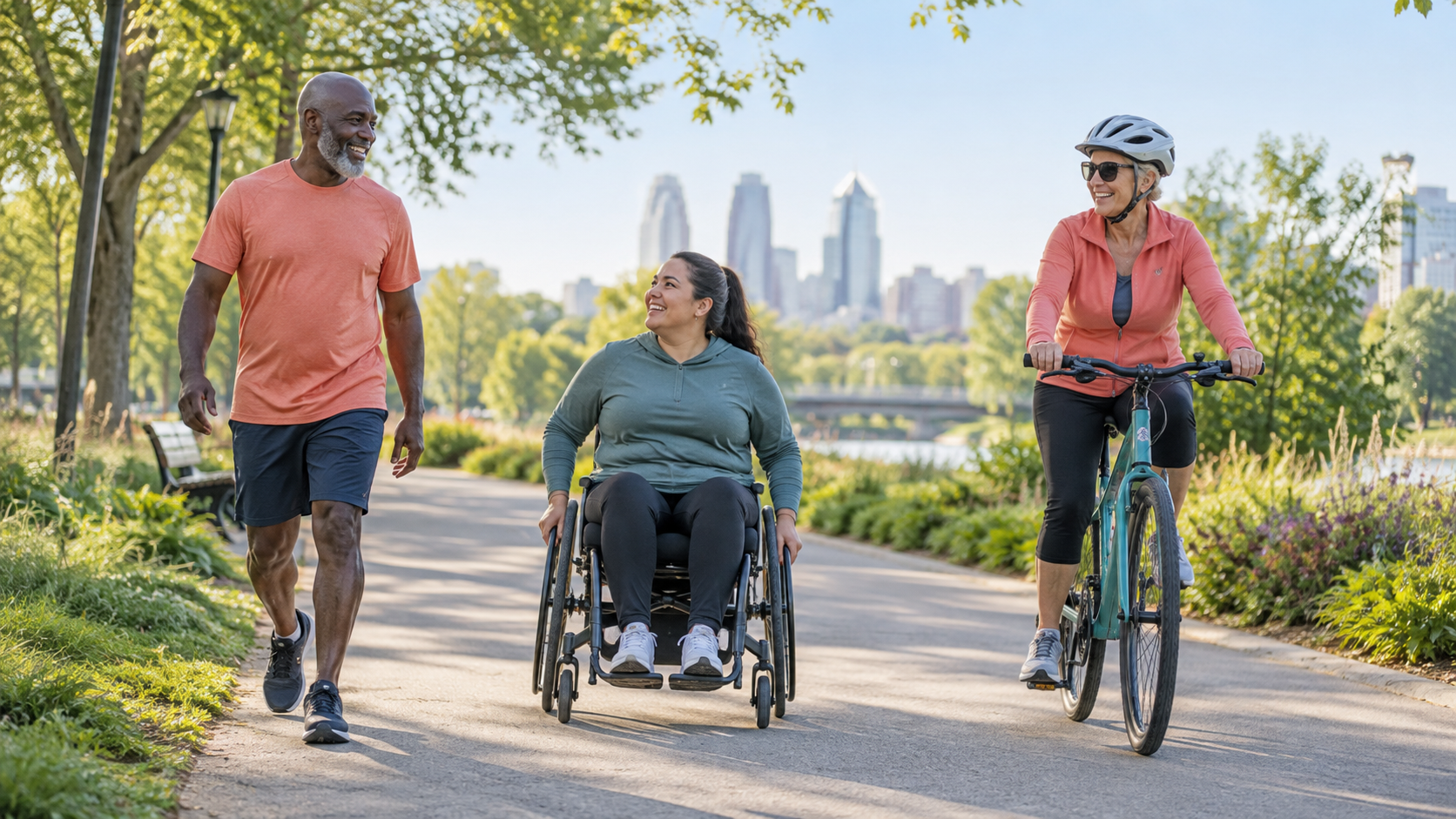
Walking is not the only option. Wheeling, cycling, dancing, swimming, active games, seated movement and adapted exercise can all involve aerobic effort. Accessibility should be part of the design, not an afterthought.
The goal is not to copy someone else's pace or appearance. A useful routine is one that can be reached safely, repeated and adapted without turning movement into punishment.
Why the participation gap matters to policy
When more than half of surveyed adults do not meet an aerobic target during leisure time, an individual-only response is unlikely to be enough. Public spaces, transport, schools, workplaces and community programmes influence who has a practical opportunity to be active.
Data broken down by population characteristics can help identify inequities, but only if the differences lead to better design rather than stigma. For example, a lower rate among disabled adults should prompt questions about inclusive facilities, transport, cost and suitable support, not an assumption about interest or effort.
Future data can show whether participation changes, but a higher percentage alone would not reveal whether movement is enjoyable, safe or equitably available. Quantitative monitoring works best alongside lived experience and local evaluation.
What the figures cannot prove
This was a cross-sectional analysis of survey responses. It cannot show that meeting the activity guideline caused a participant's health status, weight or other characteristic. Health can influence activity, and activity can influence health, while many other factors affect both.
The estimates also include statistical uncertainty. The headline percentage is a population estimate rather than an exact count. The report's value lies in tracking broad patterns with a consistent method, not ranking individual behaviour.
Key takeaways
- The latest US estimate says 47.2 per cent of adults met the federal aerobic guideline through leisure-time activity in 2024
- The measure does not capture every form of movement and cannot explain the causes of participation differences
- Practical activity advice should be flexible, inclusive and matched by safer, more accessible environments
Sources
- CDC National Center for Health Statistics: Aerobic Physical Activity Among Adults Age 18 and Older, United States, 2024
- CDC: Health Benefits of Physical Activity for Adults, updated 10 March 2026
- WHO: Physical activity fact sheet
General information disclaimer: This article provides general public-health information. It does not assess fitness or determine whether a particular activity is safe for an individual. Seek appropriately qualified advice when symptoms, disability, pregnancy, an injury or a health condition affect activity choices.